Medical Botox in Calgary: Relief for TMJ Pain, Bruxism, and Tension Headaches
When most people hear "Botox," they think cosmetic wrinkle treatment. But medical Botox is a different application entirely — one used to relax overactive jaw and facial muscles that cause chronic pain, grinding, and headaches. If you've been dealing with jaw tension, clenching, or recurring headaches that haven't responded to other treatments, medical Botox may be worth exploring with a provider in Calgary who treats it as a functional, not cosmetic, therapy.
Here's what medical Botox actually treats, how it works, and what to expect from treatment in Calgary.
Quick Takeaways
Medical Botox uses the same active ingredient as cosmetic Botox, but it's injected into specific jaw and facial muscles to relieve pain and dysfunction — not to smooth wrinkles.
It's commonly used for TMJ disorder, bruxism (teeth grinding/clenching), and tension headaches.
Treatment works by temporarily relaxing overactive muscles, which reduces the pulling and clenching forces causing pain.
Results typically appear within 3 to 7 days and last 3 to 4 months per treatment cycle.
It's often combined with other therapies, such as myofunctional therapy or craniofacial evaluation, for longer-term results.
BreatheWell Sleep and Airway offers therapeutic Botox in southwest Calgary as part of a broader jaw, airway, and sleep health approach.
What Is Medical Botox?
Medical (or "therapeutic") Botox refers to the use of botulinum toxin injections to treat muscle-related pain and dysfunction rather than cosmetic concerns. The medication itself is the same as what's used cosmetically, but the injection sites, dosing, and treatment goals are entirely different.
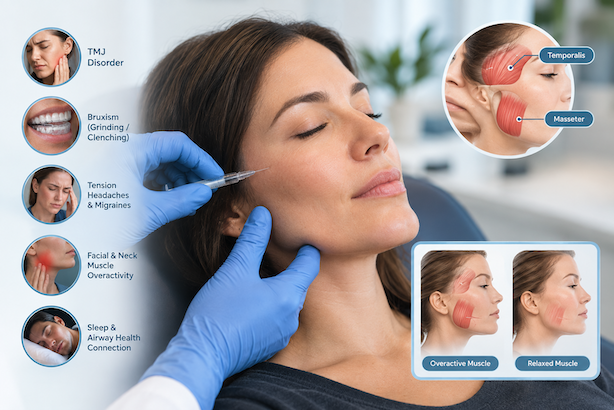
In a dental or sleep-and-airway setting, medical Botox is most often used to calm chronically overactive muscles in the jaw, temples, and neck — the muscles responsible for clenching, grinding, and much of the referred pain patients experience as headaches.
What Conditions Does Medical Botox Treat?
TMJ disorder (TMD) — jaw joint pain, clicking, or limited range of motion
Bruxism — chronic teeth grinding or clenching, especially at night
Tension headaches and migraines — particularly those linked to jaw or temple muscle strain
Facial and neck muscle overactivity related to clenching patterns
Post-treatment support following tongue tie release or craniofacial therapy, where muscle habits need to be retrained
If you've been told your headaches are "just stress" or you've tried night guards without lasting relief, muscle-based treatments like medical Botox address a mechanism those approaches don't.
How Does It Work?
Botulinum toxin works by temporarily blocking nerve signals to the muscle it's injected into, which reduces the muscle's ability to contract with full force. When injected into overactive jaw muscles — most commonly the masseter and temporalis — this means less clenching strength, less grinding pressure, and less pulling on the jaw joint and surrounding nerves.
The process typically looks like this:
Assessment — Your provider evaluates jaw movement, muscle tension, bite patterns, and headache history to confirm Botox is an appropriate treatment.
Targeted injections — Small, precise doses are injected into the specific muscles contributing to your symptoms.
Onset — Most patients notice reduced tension within 3 to 7 days, with full effect by about two weeks.
Follow-up — Results are reassessed and future treatments are adjusted based on your response.
Because the effect is temporary, treatment is typically repeated every 3 to 4 months to maintain relief.
Who Is a Good Candidate?
Medical Botox tends to be a good fit for people who have:
Diagnosed or suspected TMJ dysfunction
Chronic bruxism, especially with facial pain or worn teeth
Tension-type headaches connected to jaw or temple muscle activity
Limited relief from night guards, physiotherapy, or medication
A preference for a non-surgical, minimally invasive option
It's not typically used as a first-line treatment on its own — most providers pair it with an underlying assessment of bite, airway, and muscle function so the root cause is being addressed, not just the symptom.
How Medical Botox Connects to Airway and Sleep Health
Jaw clenching and grinding are frequently tied to airway issues — the body often clenches the jaw forward involuntarily during sleep as a way to keep the airway open. That means chronic bruxism can sometimes be a sign of an underlying sleep or breathing issue rather than a standalone dental problem.
At BreatheWell Sleep and Airway, therapeutic Botox is offered as part of a comprehensive approach that looks at the connection between jaw tension, muscle function, and airway health — often alongside myofunctional therapy or craniofacial evaluation and modification. For patients whose grinding or clenching is linked to disrupted sleep, our team may also assess for sleep apnea as part of the full picture.
Getting Medical Botox in Calgary
If you're in Calgary and dealing with persistent jaw pain, grinding, or headaches, treatment generally starts with a consultation to determine whether the source of your symptoms is muscular, airway-related, or both. From there, a treatment plan is built around your specific muscle patterns — not a one-size-fits-all injection protocol.
BreatheWell Sleep and Airway is located at #150, 10601 Southport Road SW in southwest Calgary, and provides therapeutic Botox alongside a full evaluation of jaw function, oral posture, and airway health. You can request an appointment here or learn more about our approach to jaw and airway care.
Frequently Asked Questions
Is medical Botox the same as cosmetic Botox?
It's the same medication, but medical Botox is injected into different muscles at different doses to relieve pain and dysfunction, such as TMJ pain or bruxism, rather than to reduce the appearance of wrinkles.
How long does medical Botox last for TMJ or bruxism?
Most patients see results for 3 to 4 months per treatment. Ongoing relief usually requires repeat treatments on that schedule.
Does medical Botox stop teeth grinding completely?
It significantly reduces the strength of the clenching muscles, which lessens grinding force and related pain, but it's typically most effective when combined with an assessment of underlying causes, such as bite alignment or airway issues.
Is medical Botox covered by insurance in Alberta?
Coverage varies by provider and diagnosis. Some extended health plans offer partial coverage when Botox is prescribed for a diagnosed condition like TMJ disorder; check with your provider for specifics.
Are there side effects?
Most side effects are mild and temporary, such as slight bruising at the injection site or short-term muscle weakness. Serious side effects are rare when treatment is administered by a trained provider.
Who provides medical Botox in Calgary?
BreatheWell Sleep and Airway, located in southwest Calgary, offers therapeutic Botox for TMJ pain, bruxism, and tension headaches as part of a broader jaw and airway health assessment. Request an appointment to find out if it's right for you.