

Do I need a referral for a tongue‑tie release?
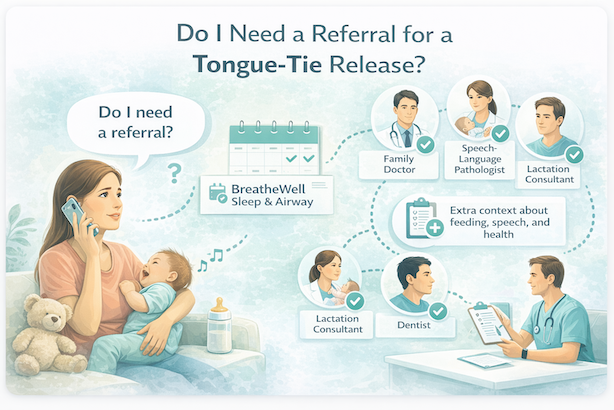
If you live in Calgary or the surrounding area and are wondering whether you need a referral for a tongue‑tie release, you are not alone.
In Alberta, many clinics that assess and treat tongue ties accept self‑referrals from parents and adults who are concerned about breastfeeding, speech, or airway issues, and BreatheWell Sleep & Airway is one of them.
BreatheWell Sleep & Airway in Calgary specifically invites families to book a tongue‑tie assessment directly, without a doctor’s referral.
That said, a referral from your family doctor, lactation consultant, speech‑language pathologist, dentist, or other therapist in the Calgary area can be very helpful because it adds context about feeding, growth, speech, and overall health. A collaborative approach is ideal: your healthcare team identifies issues like tongue clicking while nursing, poor weight gain, or unclear speech, and BreatheWell evaluates whether a tongue‑tie release should be part of the solution.
In short for Calgary families:
Referral usually not required to contact or book a tongue‑tie assessment at BreatheWell Sleep & Airway in Calgary.
Referral often recommended so tongue tie can be evaluated alongside broader feeding, speech, dental, and airway health.
What Is a Tongue Tie and Why Does It Matter?
Tongue tie (ankyloglossia) happens when the lingual frenulum, the small band of tissue connecting the underside of the tongue to the floor of the mouth, is too short, tight, or thick and restricts movement. When the tongue cannot move freely, it may affect breastfeeding, speech, oral development, and airway health across the lifespan.
Newborns and infants
In newborns, a tongue tie can cause:
Trouble latching and staying on the breast.
Tongue clicking while nursing, where you hear a rhythmic “click” as the seal repeatedly breaks.
Prolonged feeds, poor weight gain, or a baby who seems constantly hungry despite good milk supply.
Painful, damaged nipples and frustration for the breastfeeding parent.
These are common reasons Calgary parents seek help for newborn tongue tie healing and feeding support.
Children
As a child grows, the same restriction can show up in different ways:
Difficulty with certain speech sounds like “t, d, s, z, n, l, th,” and sometimes a lisp, because the tongue cannot reach where it needs to for precise articulation.
Problems sweeping food from the teeth, contributing to cavities and gum inflammation.
Mouth breathing, jaw tension, or abnormal oral posture that can influence facial growth and airway.
Teens and adults
In teens and adults, untreated tongue tie can contribute to:
Chronic jaw, neck, or facial tension and headaches.
Snoring, poor sleep, and airway‑related problems, especially when combined with narrow jaws or a high palate.
Ongoing tongue tie health issues, such as digestive discomfort from poor chewing, mouth breathing, and difficulty maintaining oral hygiene.
This is why BreatheWell emphasizes function, not appearance—what matters is how the tongue tie affects feeding, speech, oral posture, and airway, rather than how it looks alone.
What Is the Tongue Tie Operation Name?
Parents often start by Googling the tongue tie operation name when they begin researching treatment options in Calgary.
The most common procedure names are:
Frenotomy (lingual frenotomy): A quick procedure that releases or divides the restrictive frenulum to free tongue movement.
Frenectomy: Removal of more of the frenulum tissue; sometimes used interchangeably with frenotomy, though technically involves more extensive tissue removal.
Frenuloplasty: A more complex surgery with repositioning of tissue and sutures, usually reserved for certain anatomical situations or older patients.
At BreatheWell Sleep & Airway in Calgary, tongue ties are released using a highly specialized LightScalpel laser technique. The goal is precise, minimally invasive treatment that supports smooth newborn tongue tie healing and long‑term tongue function.
How BreatheWell Sleep & Airway in Calgary Approaches Tongue‑Tie Release
BreatheWell offers evidence‑based tongue‑tie treatment in Calgary for newborns, children, teens, and adults, with a focus on airway and whole‑body function, not just the tie itself. Calgary families can self‑refer or come with a referral from their existing providers.
Comprehensive assessment
The team evaluates:
Tongue mobility and function
Feeding or speech concerns
Oral posture and nasal vs. mouth breathing
Dental and jaw development
Sleep and airway function
This full picture helps decide whether a tongue‑tie release is appropriate or whether other therapies should come first.
Precise release with advanced technology
BreatheWell uses the LightScalpel laser, a CO₂ laser system specifically designed for soft‑tissue procedures like tongue‑tie releases, and they are currently the only clinic in Calgary offering this technology for tongue ties. This supports a very controlled release with minimal bleeding, less swelling, and predictable healing compared to older methods.
Post‑procedure support and exercises
Families receive guidance on tongue tie exercises and aftercare to maintain mobility, support newborn tongue tie healing, and promote healthy oral posture over time. BreatheWell frequently works with lactation consultants, myofunctional therapists, and other local providers to optimize results for Calgary families.
Care across the lifespan
BreatheWell sees:
Newborns with breastfeeding challenges and tongue clicking while nursing
Older babies and children with speech or oral development issues
Teens and adults with restricted tongue movement, jaw tension, snoring, or suspected airway problems
Newborn Tongue Tie: Signs, Healing, and Recovery
Signs in newborns
Common red flags that prompt Calgary parents to ask about a tongue tie include:
Tongue clicking while nursing, often accompanied by frequent unlatching or gulping.
Difficulty maintaining a deep latch, prolonged feeds, or poor weight gain despite good milk supply.
Maternal nipple pain, compression stripes, or recurrent nipple damage.
Excessive drooling during feeds or between feeds, especially if combined with milk leaking and a very “messy” latch. While not specific on its own, this can be part of the picture when a baby cannot create a strong seal.
If breastfeeding support and positioning adjustments have not solved the problem, a tongue‑tie assessment at a Calgary clinic like BreatheWell Sleep & Airway is often the next step.
Newborn tongue tie healing and recovery
Parents understandably worry about newborn tongue tie healing and what recovery looks like for their baby.
Evidence and clinical experience show that:
A frenotomy in newborns is typically a quick in‑office procedure, often done with scissors or laser, and many babies can feed immediately afterward.
Most newborns do not require general anesthesia; comfort measures such as feeding right after the procedure and, in some settings, oral sucrose may be used.
Within days, feeding often becomes more efficient as the baby relearns how to use a now‑freer tongue, especially with lactation or feeding support.
At BreatheWell, post‑procedure support includes exercises and gentle stretches designed to maintain range of motion, guide tongue posture, and support tongue tie newborn recovery. Collaboration with a Calgary lactation consultant can significantly improve the speed and quality of breastfeeding improvement after release.
Does Tongue Tie Cause a Lisp, Drooling, or Other Long‑Term Issues?
Speech: does tongue tie cause a lisp?
Tongue tie can contribute to speech difficulties in some children and adults, particularly with sounds that require the tongue to elevate or reach the palate, such as “t, d, n, l, s, z, th.” For some, this presents as a lisp or unclear articulation because the tongue cannot move where it needs to for crisp consonants.
Not everyone with a tongue tie will develop a lisp, but when a mechanical restriction is present along with articulation issues, assessment can help determine whether release plus speech‑language therapy would improve outcomes. This is part of how tongue tie effects later in life show up: compensatory speech patterns, reduced clarity, and even social or emotional impacts from feeling self‑conscious about speech.
Drooling: does tongue tie cause excessive drooling?
Excessive drooling in babies and toddlers is often related to normal development or teething, but limited tongue mobility can play a role. A restricted tongue may make it harder to:
Maintain a good lip seal and swallow saliva efficiently.
Coordinate swallowing during feeding, resulting in milk or saliva leaking from the sides of the mouth.
So while tongue tie is not the only cause of excessive drooling, it can be a contributing factor when combined with other symptoms like feeding challenges, mouth breathing, or speech delays. In older children, persistent drooling and difficulty with saliva control may warrant a combined evaluation of tongue mobility, oral posture, and neuromuscular control.
Other tongue tie health issues later in life
If not addressed when clearly symptomatic, tongue tie effects later in life may include:
Abnormal jaw and dental development, such as a high palate or narrow upper jaw, which can make the airway smaller.
Difficulty chewing thoroughly, leading to digestive issues and increased gas or bloating.
Mouth breathing, snoring, and potentially worse sleep quality, especially in those predisposed to airway issues.
Increased risk of cavities and gum disease due to difficulty sweeping food from teeth and the gumline.
BreatheWell’s airway‑focused model specifically looks at these long‑term tongue tie health issues, integrating tongue‑tie care with broader sleep and breathing assessments for Calgary patients.
Can You Fix a Tongue Tie Naturally?
Many parents ask whether exercises alone can fix a tongue tie. Current understanding suggests:
Exercises and therapy can help optimize function in mild restrictions, improve tongue awareness, and support better feeding technique.
However, exercises alone cannot lengthen or remove restrictive frenulum tissue; they do not replace a frenotomy or frenectomy when a true anatomical restriction is present.
BreatheWell uses exercises:
Before a release: to prepare the tongue and nervous system, improving control and awareness.
After a release: to maintain the new range of motion and support ideal oral posture, promoting long‑term benefits.
A careful assessment at BreatheWell Sleep & Airway in Calgary helps decide whether conservative measures are enough or whether a tongue‑tie release should be considered for durable improvement.
Tongue‑Tie Release in Calgary: How to Book at BreatheWell Sleep & Airway
You might consider a tongue‑tie assessment at BreatheWell Sleep & Airway in Calgary if:
Your newborn has persistent feeding issues, tongue clicking while nursing, or poor weight gain despite lactation support.
Your child has unclear speech, suspected lisp, mouth breathing, or dental crowding and a narrow palate.
You as a teen or adult notice restricted tongue movement, chronic jaw or neck tension, snoring, or suspected airway problems.
Because BreatheWell accepts direct bookings, you can contact the clinic even if you do not have a formal referral, then loop your other providers into the plan.
After a comprehensive assessment, the team will explain whether a tongue‑tie release is recommended, what type of procedure is most appropriate, and what newborn tongue tie healing or adult recovery will look like for you or your child.
👉 BOOK YOU YOUR TONGUE TIE ASSESSMENT TODAY
FAQ: Tongue‑Tie Release in Calgary
1. Do I need a referral for a tongue‑tie release in Calgary?
Most families do not need a referral to book a tongue‑tie assessment at BreatheWell Sleep & Airway in Calgary. You can self‑refer, and we are happy to see you even if your family doctor or lactation consultant has not sent a formal referral. Referrals from Calgary healthcare providers are always welcome and help us better understand your baby’s or child’s feeding, speech, and airway history.
2. How do I book a tongue‑tie assessment near me in Calgary?
You can contact BreatheWell Sleep & Airway directly to book a tongue‑tie assessment for your newborn, child, teen, or yourself. Our Calgary clinic provides comprehensive evaluations of tongue function, breastfeeding or bottle‑feeding, speech, jaw growth, and airway so you can decide whether a tongue‑tie release is the right next step.
3. What does newborn tongue tie healing and recovery look like?
Newborn tongue tie healing is usually quick, because a frenotomy is a short in‑office procedure and most babies can feed right away afterward. Tongue tie newborn recovery typically involves some mild fussiness for a day or two, then gradual improvement in latch, milk transfer, and comfort as your baby relearns how to use their tongue, especially with good lactation support.
4. Is tongue clicking while nursing always caused by a tongue tie?
Tongue clicking while nursing is a common sign of a shallow latch or poor seal, and tongue tie is one possible cause, but not the only one. If you hear frequent clicks, notice slipping off the breast, or see poor weight gain, a Calgary lactation consultant and a tongue‑tie assessment at BreatheWell can help determine whether a tongue tie is part of the problem.
5. Does tongue tie cause a lisp or speech problems later in life?
Tongue tie can contribute to a lisp or difficulty making certain sounds, especially “t, d, n, l, s, z, th,” when the tongue cannot reach the palate or teeth properly. Not every child with a tongue tie will have a lisp, but if speech is unclear, a combined assessment with a speech‑language pathologist and BreatheWell Sleep & Airway in Calgary can clarify whether a tongue‑tie release might help.
6. Can tongue tie cause excessive drooling or other health issues?
Tongue tie can make saliva control harder and may contribute to excessive drooling when combined with feeding difficulties or mouth breathing, but it is not the only cause. Over time, a significant tongue tie can also be linked to tongue tie health issues such as jaw and dental crowding, mouth breathing, snoring, and problems chewing food thoroughly.
7. What is the tongue tie operation name, and is it safe for my baby?
The tongue tie operation name most parents will hear is “frenotomy,” and in some cases “frenectomy” or “frenuloplasty,” depending on how much tissue is released. For newborns, a frenotomy is a quick, low‑risk procedure that can often be done in the clinic, and most Calgary families find that feeding becomes easier in the days and weeks after release when they receive good follow‑up and breastfeeding support.