
CPAP Leaking Air? Find the Leak or Go Mask-Free | Calgary
Quick Takeaways
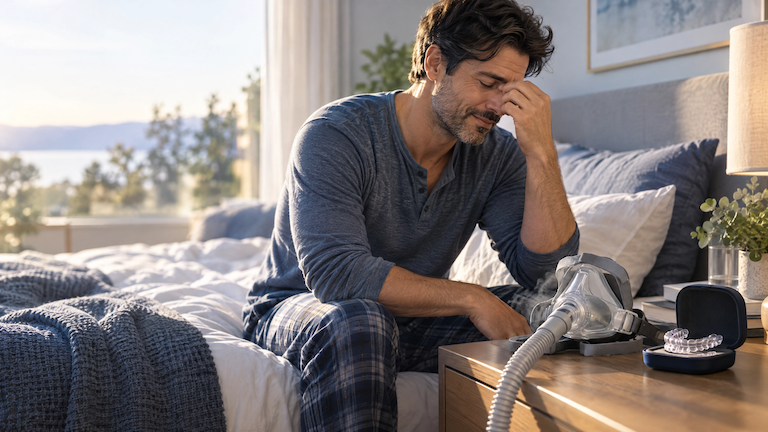
Hissing, dry eyes, a dry mouth, and red marks on your face are the classic signs of a CPAP leak.
Start with the easy fixes: a mask refit, a fresh cushion, looser straps, or a chin strap.
Leaks that keep coming back often point to mask fit, face shape, sleep position, or mouth breathing, which a new cushion won't solve.
Oral appliance therapy has nothing to leak. This custom dental device treats obstructive sleep apnea without a mask, hose, or air pressure.
Calgary patients can be fitted in SW Calgary by Dr. Saleema Adatia, a Diplomate of the American Board of Dental Sleep Medicine.
Find Your Leak: A Symptom-by-Symptom Guide
Most CPAP leaks come from the mask, not the machine. Match what you're noticing to the likely cause:
What you notice | Likely cause | Try this |
|---|---|---|
Air blowing into your eyes | Mask sits too high or is the wrong size | Ask your CPAP provider for a refit |
Hissing around the cushion | Worn cushion or oily skin | Replace the cushion (every 1–3 months) and wash your face before bed |
Dry mouth when you wake up | Your mouth falls open with a nasal mask | Try a chin strap or full-face mask |
Red marks or a sore nose bridge | Straps pulled too tight | Loosen straps; snug, not tight |
Leaks only when you roll over | Pillow pushing the mask out of place | Try a CPAP pillow or a different mask style |
High leak numbers in your CPAP app | Any of the above | Review your data with your CPAP provider |
When the Leak Is the Reason You Stop
Some people fix their leak in a night. Others try three masks, two chin straps, and a box of cushions, and still wake up to hissing. Over time, many give up on CPAP altogether.
The problem is that unused CPAP means untreated sleep apnea. If you're stuck in that cycle, it may be time to look at a treatment with no seal to break: oral appliance therapy.
Nothing to Leak: How Oral Appliance Therapy Works
An oral appliance is a custom-made device that fits over your upper and lower teeth, much like a sports mouthguard or retainer. It gently holds your lower jaw slightly forward while you sleep.
That small shift keeps your tongue and throat tissues from collapsing into your airway. You breathe on your own, with no pressurized air. Without air pressure, there's nothing to escape around a cushion or out of your mouth.
A Night with CPAP vs. a Night with an Oral Appliance
With CPAP: You fit the mask, tighten the straps, and connect the hose. If you roll onto your side, the seal may shift. If your mouth drops open, air rushes out and you wake up dry. Your partner hears the machine and any leaks. Every few months, you buy new cushions, masks, tubing, and filters.
With an oral appliance: You slip the appliance in and go to sleep in any position. It's silent, so your partner sleeps too. In the morning, you rinse it and put it in its pocket-sized case. There are no monthly supplies to reorder.
CPAP is still a highly effective treatment for people who use it consistently, and it remains the standard for severe sleep apnea. But the best treatment is the one you'll actually use every night. Some patients with severe apnea combine both.
5 Reasons Leak-Weary Patients Choose an Oral Appliance
No seal to maintain. Beards, side sleeping, and face shape don't matter.
Quiet nights. No machine noise and no hissing, which also helps with snoring (see our snoring treatment options).
No air in your eyes or mouth. No more waking up with dry eyes or a parched mouth from a leak.
Easy to travel with. No power cord, distilled water, or carry-on space needed.
A recognized treatment. Oral appliances are an option for mild to severe obstructive sleep apnea, and for people who can't tolerate CPAP.
Is an Oral Appliance Right for You? A Quick Self-Check
An oral appliance may suit you if most of these sound familiar:
I've been diagnosed with mild to severe obstructive sleep apnea
I have severe sleep apnea, but I can't keep my CPAP sealed or comfortable
I sleep on my side or stomach
I have a beard or facial features that make a mask seal hard
I travel, camp, or sleep away from home often
I have enough healthy teeth to support an appliance
You'll need a sleep study and diagnosis before treating sleep apnea.
Your Path to Better Sleep at BreatheWell, Visit by Visit
Your first visit. Dr. Adatia reviews your sleep study, your symptoms, and your CPAP history, including the leaks you've been fighting. She checks your bite, jaw joints, and airway. When it's relevant, this includes a full craniofacial evaluation. If you're a good fit, we take digital impressions so your appliance can be custom-made.
Fitting day. We fit your new appliance and adjust it for comfort. You'll learn how to put it in, take it out, and clean it.
The weeks that follow. We fine-tune your jaw position step by step and confirm your results, often with a follow-up sleep test. Mild jaw or tooth tenderness in the morning is common early on and usually fades within minutes. Brush or rinse the appliance each morning, let it air dry in its case, and bring it to your check-ups. With good care, it typically lasts several years.
Extra support, if you need it. If mouth breathing was behind your CPAP leaks, breathing re-education and myofunctional therapy can retrain nasal breathing and strengthen your airway muscles.
Paying for Your Oral Appliance
An oral appliance is a one-time device with occasional check-ups, not an ongoing supply bill. Alberta Health Care generally doesn't cover CPAP or oral appliances for most adults. However, many extended health benefit plans cover part of the cost when you have a sleep apnea diagnosis and a prescription. We'll help you understand your coverage before you start, and our sleep apnea cost and insurance page has more detail.
Stop Fighting Your Mask: Visit Us in SW Calgary
BreatheWell Sleep and Airway is located inside Symmetry Dental at #150, 10601 Southport Road SW, Calgary. Patients come to us from across the city, including Southwood, Haysboro, Acadia, Lake Bonavista, and Willow Park. Explore all our CPAP alternatives and sleep apnea treatment options.
Request an appointment online or call (403) 225-4459.
Your CPAP Leak Questions, Answered
Q: Is some air leak from a CPAP mask normal? A: Yes, a little. Masks have built-in vents that release air on purpose. Air escaping around the cushion, into your eyes, or out of your mouth is not normal and should be fixed.
Q: What causes a CPAP to leak air? A: Usually the mask. A poor fit, a worn cushion, overtightened straps, oily skin, facial hair, side sleeping, or an open mouth can all break the seal.
Q: How can I stop air leaking out of my mouth? A: A chin strap or full-face mask often helps. If you're a habitual mouth breather, breathing re-education can retrain you to breathe through your nose.
Q: Can I treat sleep apnea without a mask? A: Yes. Custom oral appliance therapy treats obstructive sleep apnea with a device worn in your mouth, with no mask or air pressure.
Q: Does an oral appliance work as well as CPAP? A: In a sleep lab, CPAP reduces more breathing events. In everyday life, oral appliances often deliver similar results because people wear them more consistently.
Q: How is a custom appliance different from a drugstore anti-snoring mouthguard? A: A custom appliance is made from impressions of your teeth and adjusted by a trained dentist. Over-the-counter devices aren't designed or monitored to treat sleep apnea.
Q: Will insurance help pay for an oral appliance in Alberta? A: Alberta Health Care generally doesn't cover it for most adults. Many extended health plans cover part of the cost with a diagnosis and prescription, and we can help you check.
Q: Do I need a referral to see BreatheWell? A: No referral is required. Dentists and physicians can also refer patients through our referrals page.